

Blog Details
Cable Tray Sizing and BOQ Planning for Saudi MEP Projects: A Practical Guide
By GBT Author • 10/27/2026
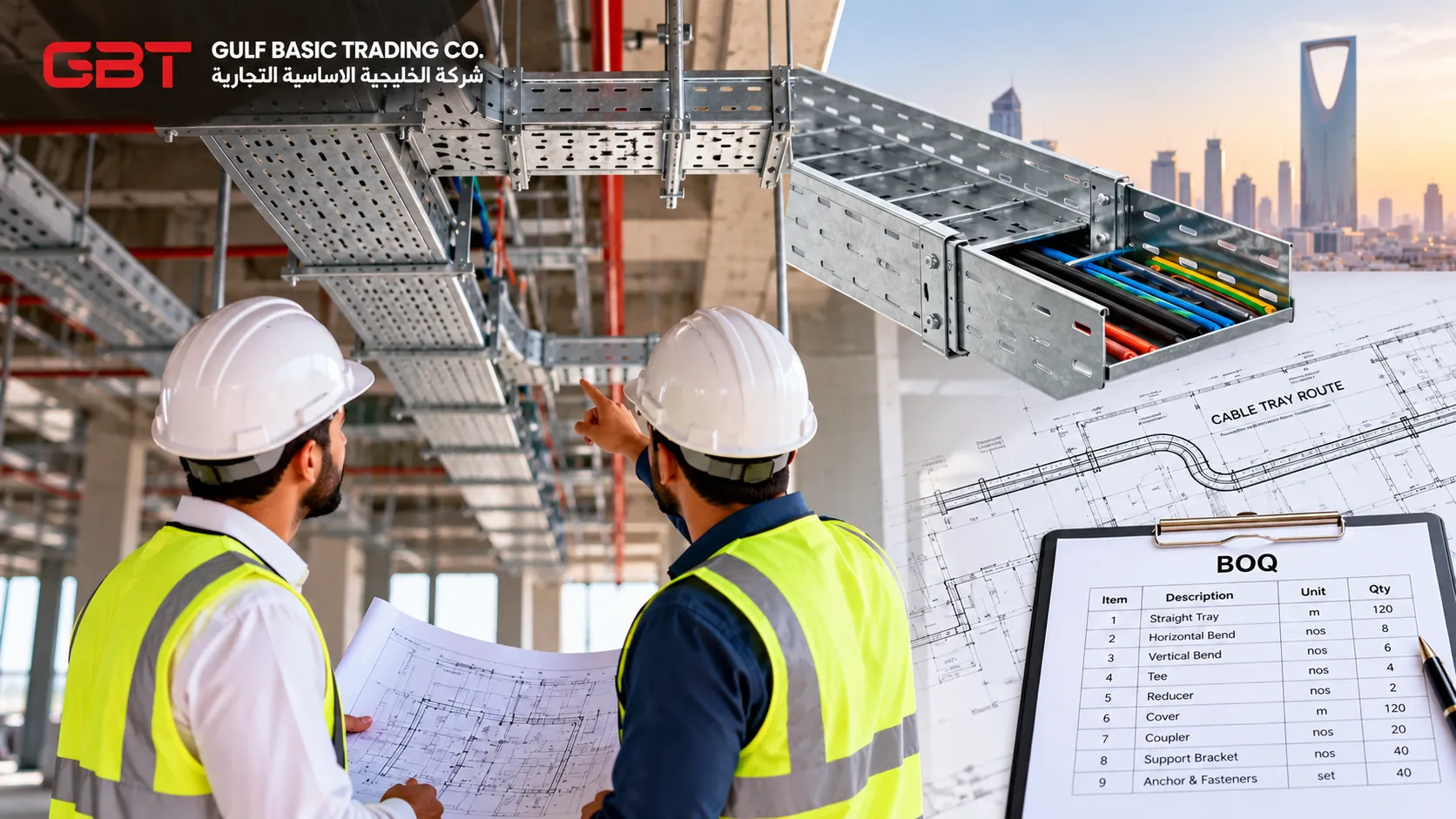
Selecting cable trays for an MEP project involves more than choosing a width and ordering standard lengths. Electrical contractors and procurement teams must consider cable quantities, dimensions, loading, support arrangements, installation conditions and accessories. A well-prepared bill of quantities (BOQ) helps align the material order with the approved design, reducing missing components, unnecessary purchases and installation delays.
What Information Is Needed to Estimate Cable Tray Requirements?
Cable tray sizing is the process of determining a suitable tray configuration for the cables it must support. The selection depends on the cable schedule, cable dimensions, installation environment, required capacity and project specifications.
Before estimating quantities, collect these details:
- Cable schedule showing cable types, quantities and outside diameters.
- Cable weights or manufacturer data where required for load calculations.
- Approved routing drawings and route lengths.
- Required tray material, finish and configuration.
- Support arrangement and specified support spacing.
- Fittings, covers and accessories required by the design.
- Project-specific technical requirements and documentation.
If key information is missing, clarify it with the design or engineering team before finalising the BOQ.
Step 1: Determine the Required Tray Width
The required tray width depends on the number, dimensions and arrangement of the cables, together with applicable installation requirements.
Start by reviewing the cable schedule and identifying which cables share each route. Use manufacturer cable dimensions and the approved cable arrangement to assess the required usable tray width.
Do not simply add cable diameters and assume the result is an approved tray size. Cable spacing, grouping, segregation, bending requirements, thermal considerations and future capacity may affect the design.
For routes containing different cable types, verify whether the project requires separate containment systems or specific separation arrangements.
Procurement tip: Include the specified tray width, depth, type and material in the RFQ. This allows suppliers to quote against a clear requirement rather than making unsupported assumptions.
Step 2: Verify Cable Loading and Support Requirements
A tray that physically accommodates the cables may still be unsuitable for the required load or span.
The engineering review should consider:
- Cable weight per unit length.
- Total cable load along the route.
- Tray configuration and manufacturer load ratings.
- Support spacing and span.
- Fittings, cantilevers and connection arrangements.
- Any additional loads specified by the design or manufacturer.
Use the selected manufacturer's load tables for the relevant tray configuration and support span. Do not apply a load rating from one tray model to another simply because their dimensions appear similar.
The final tray selection and support arrangement must comply with the approved engineering design and applicable project requirements.
Step 3: Estimate the Tray Length
Once the route and tray specification are established, the preliminary straight-tray quantity can be estimated from the approved routing drawings.
For example, if an approved route requires 120 metres of straight tray, the initial straight-section requirement is 120 metres before accounting for the project's cutting plan, standard stock lengths and any approved spare allowance.
The purchase quantity must then be translated into the available standard lengths. Account for practical cutting requirements without double-counting sections or treating fitting lengths as additional straight runs when they are already included in the route measurement.
Separate the estimate by tray type, width, depth and finish whenever the project specification requires different configurations.
Step 4: Prepare a Complete Cable Tray BOQ
A common procurement problem is estimating the main tray sections while overlooking the components needed to complete the installation.
Depending on the approved design, a cable tray BOQ may include:
| BOQ item | What to specify |
|---|---|
| Straight tray sections | Type, width, depth, finish and standard length |
| Horizontal bends | Required angle, dimensions and compatibility |
| Vertical bends | Upward or downward configuration |
| Tees and cross fittings | Branch arrangement and dimensions |
| Reducers | Transition between specified tray widths |
| Covers | Required type, material and finish |
| Couplers and connectors | Compatible connection system |
| Support brackets | Approved type, loading and fixing arrangement |
| Anchors and fasteners | Type and specification required by the design |
| Earthing or bonding accessories | Where required by the applicable design and specification |
Not every installation requires every item in this table. Confirm quantities against the drawings, fitting schedule and manufacturer's system.
Step 5: Account for Saudi Project Conditions
Cable management systems used in Saudi Arabia should be selected according to the actual installation environment and project requirements.
Consider whether the route is indoors or outdoors, exposed to high ambient temperatures, dust, moisture or corrosive conditions. Coastal and industrial environments may require particular attention to corrosion protection and material compatibility.
The tray material and finish should be specified according to the project documents and manufacturer's recommendations. Galvanized steel, stainless steel and other available finishes are not interchangeable in every environment.
For electrical installations, consult the applicable edition of the Saudi Electrical Code (SBC 401) and the project's approved specifications. The relevant requirements depend on the installation and should be verified by the responsible electrical engineer.
Step 6: Check the BOQ Before Requesting a Quotation
Before issuing an RFQ, review the following checklist:
- Tray types and dimensions match the approved drawings.
- Route lengths have been checked against the latest drawing revision.
- Cable loads and support requirements have been verified by the engineering team.
- Bends, tees, reducers and other required fittings are included.
- Covers, couplers, supports and fasteners are accounted for.
- Material and corrosion-protection requirements are stated.
- Required technical datasheets and submittals are identified.
- Quantities, standard stock lengths and delivery requirements are clear.
- Any proposed product substitution is subject to the required approval.
A clear BOQ helps suppliers prepare comparable quotations and helps procurement teams identify missing items before the order is placed.
Common Cable Tray Procurement Mistakes
Estimating from route length alone: Route length is only one part of the requirement. Fittings, supports, connectors and changes in tray dimensions can significantly affect the final order.
Ignoring the manufacturer's load tables: Tray capacity depends on the system configuration and support span. Verify the actual rating instead of relying on a generic capacity assumption.
Ordering incompatible accessories: Fittings and connectors should be compatible with the selected tray system. Mixing components without confirming compatibility can cause installation problems.
Using outdated drawings: Changes to cable routes or equipment locations may alter tray quantities and fitting requirements. Confirm the latest approved drawing revision before ordering.
Failing to coordinate delivery: Where a project requires phased installation, align delivery quantities with the construction schedule and available site storage.
Sourcing Cable Trays for Saudi MEP Projects
Gulf Basic Trading supplies cable trays for cable management applications in construction and industrial projects.
When requesting a quotation, share the required tray type, dimensions, finish, quantities, accessories, project location and delivery schedule. Include the approved BOQ or relevant technical specifications where available.
This information helps establish the required supply scope and supports a more accurate quotation. Final product selection should be confirmed against the project's technical requirements and applicable manufacturer documentation.
Frequently Asked Questions
How do you calculate cable tray size?
Review the cable schedule, cable outside diameters, arrangement, installation requirements and project specifications. Verify the proposed configuration against applicable design requirements and manufacturer information before finalising the size.
How do you estimate cable tray quantities?
Measure the approved routing drawings, identify each tray specification and convert the route lengths into available standard sections. Add the fittings, connectors, supports and other components shown in the approved design.
How do you determine cable tray load capacity?
Use the relevant manufacturer's load tables for the selected tray configuration and support span. The responsible engineer must verify the load assumptions and support arrangement for the actual installation.
What accessories should be included in a cable tray BOQ?
Depending on the design, the BOQ may include bends, tees, reducers, covers, couplers, supports, anchors, fasteners and required bonding accessories. Confirm the actual requirement against the approved drawings.
What should be considered when selecting cable trays in Saudi Arabia?
Consider cable loading, installation conditions, ambient temperature, dust, moisture, corrosion exposure, material finish and project specifications. Verify applicable electrical-code and project requirements for the specific installation.
Where can I source cable trays for projects in Saudi Arabia?
You can review Gulf Basic Trading's cable tray product page and enquire with the team. Provide your BOQ, technical requirements, quantities and delivery location to support the quotation process.
Final Thoughts
Accurate cable tray planning starts with approved drawings, verified cable requirements and the correct support configuration. A complete BOQ should account for straight sections, fittings, supports and compatible accessories – not just total route length.
For Saudi MEP projects, verify the technical specification and installation conditions before procurement. Clear documentation and a well-prepared material schedule help contractors reduce ordering errors and coordinate supply more effectively.
Call Us Now !
Drop Us a Line