

Blog Details
Saudi Civil Defence & Aramco Compliance Sourcing Guides: How Smart Material Choices Protect Your Project
By GBT Author • 6/1/2026
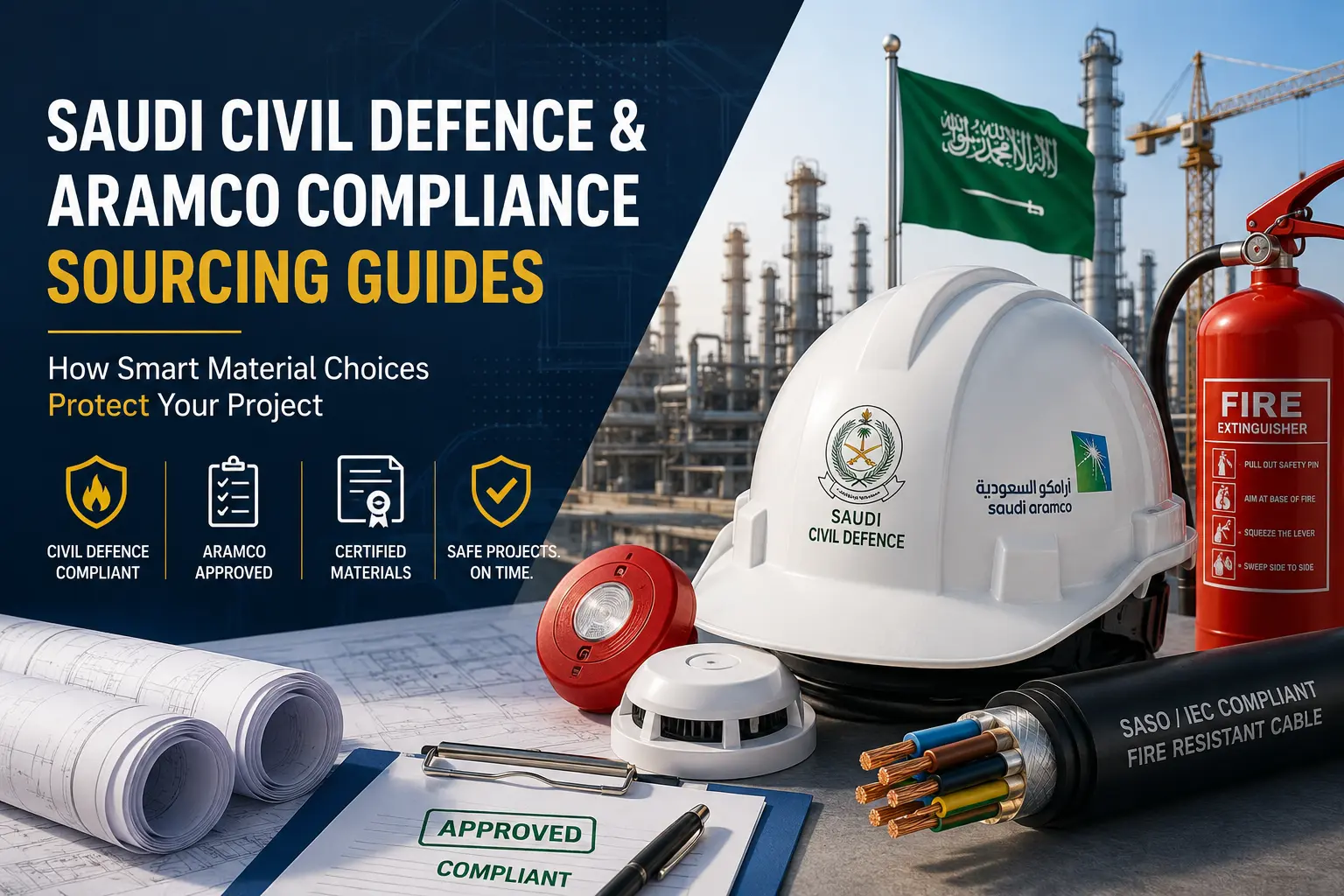
On most Saudi projects, the biggest material problem isn’t just price or stock. It’s compliance – getting the right products, with the right certificates, approved by Saudi Civil Defence and, on oil & gas jobs, by Aramco before the first inspection.
For project managers, QA/QC engineers, and procurement teams, a single non‑compliant cable, fitting, or fire‑safety device can delay testing and commissioning, handover – and in some cases, building operation itself. This is where choosing the right material supplier becomes a strategic decision, not an afterthought.
In this guide, we’ll break down what Civil Defence and Aramco compliance really mean for materials, and how a sourcing‑focused partner like Gulf Basic Trading (GBT) can simplify the process.
1. What “Saudi Civil Defence compliant” really means for materials
Saudi Civil Defence regulations cover fire and life‑safety requirements across buildings, factories, warehouses, and public facilities. For materials and equipment, that usually translates into three core expectations:
- Right product type – Fire alarm devices, emergency lighting, cables, extinguishers, fire doors, and other critical items must match approved standards and installation guidelines.
- Right documentation – Test reports, conformity certificates (including SASO where applicable), and installation manuals must be available and aligned with Saudi Building Code and Civil Defence requirements.
- Right installation – Even a compliant product can fail inspection if it is installed incorrectly, mixed with non‑approved accessories, or not supported by as‑built documentation.
In practice, this means Civil Defence inspectors and consultants will often ask:
- Is this model tested and certified to the relevant standard?
- Does the contractor have up‑to‑date test reports and approvals?
- Is the system – not just the product – designed and installed in a compliant way?
If the answer is unclear, your inspection can be delayed or rejected.
2. What “Aramco compliant” means in the real world
On Aramco projects, material compliance goes a step further. Beyond international and Saudi standards, Aramco specifications (SAES, SAMSS, 9COM codes) and internal approval workflows define what is acceptable.
Key realities for suppliers and contractors:
- Approved specs and vendors – Many materials must match specific SAES/SAMSS requirements, and in some categories, only pre‑qualified manufacturers and models are accepted.
- Vendor registration and evaluation – Aramco may inspect factories, review QA systems, and verify that materials can consistently meet spec before regular supply is allowed.
- Strict documentation and inspection – Material certificates, inspection reports, and traceability records are often checked at multiple stages of the procurement and installation cycle.
For contractors, this means you cannot treat Aramco jobs like regular projects. Materials must be chosen with approval and traceability in mind from day one.
3. Typical compliance traps in material sourcing
Across Vision 2030 projects and private developments, we see a few recurring mistakes that create compliance headaches for project teams in Saudi Arabia.
- Price‑only decisions – Choosing the lowest‑cost option without checking Civil Defence approvals, Aramco compatibility, or documentation leads to submittal rejections and re‑ordering later.
- Mixed, non‑integrated systems – For fire detection, cabling, and emergency lighting, mixing components from many unrelated brands can make it difficult to prove system‑level compliance and get approvals.
- Missing or incomplete documents – Test reports, declarations of conformity, SASO certificates, and manufacturer approvals may be missing, expired, or not aligned with the actual models delivered to site.
- Late involvement of the supplier – Calling the supplier only after the design and submittals are fixed removes the chance to value‑engineer with compliant, readily available alternatives.
Each of these traps adds cost, time, and risk – all of which can be reduced by treating compliance as part of your sourcing strategy.
4. Building a Saudi Civil Defence‑ready sourcing checklist
Before you place any order for life‑safety and fire‑critical materials, use a simple Civil Defence compliance checklist. For each product or system, confirm:
- Relevant standard – Is the product certified to the correct standard (for example, fire alarm devices, fire‑resistant cables, emergency lights, fire doors)?
- Valid documentation – Do you have up‑to‑date test reports, compliance certificates, and manufacturer data sheets in English/Arabic as required?
- Compatibility with Saudi Building Code – Does the material's performance (e.g., fire rating, IP rating, temperature rating) match the risk category and location defined by SBC and Civil Defence guidance?
- System integration – If it's part of a system (fire detection, emergency lighting, etc.), is the rest of the system approved as a whole, not just individual devices?
- Supplier support – Can your supplier assist with extra documents, replacement of non‑approved models, and clarifications during inspection if needed?
Working with a supplier that understands these questions up front saves you from rework at the submittal or inspection stage.
5. Aramco compliance: sourcing strategy, not paperwork
For Aramco‑linked projects, start with the mindset that material approval is a project in itself. A practical Aramco sourcing strategy usually includes:
- Early identification of SAES/SAMSS/9COM requirements – Map your BOQ against specific Aramco material specs and identify any category that has strict approval or limited vendor lists.
- Shortlisting compliant brands and models – Work with suppliers who already know which brands and product lines are commonly accepted on Aramco jobs in your category.
- Document‑ready material options – Choose materials where test reports, type approvals, and manufacturer certifications are already available, not “to be requested later.”
- Close coordination with QA/QC and engineering – Ensure QA/QC and design teams are aligned with procurement so that substitutions don’t break compliance later in the project.
This approach turns your supplier into a compliance partner who helps you get materials approved once, not multiple times.
6. How Gulf Basic Trading supports compliance‑focused sourcing
For many Saudi contractors, the challenge is not understanding that compliance is important – it is finding a supplier who works at that level. This is where a sourcing‑driven partner like Gulf Basic Trading can add real value.
GBT can help by:
- Recommending compliant product ranges – Suggesting cables, conduits, fire‑safety devices, PPE, and electrical accessories aligned with Saudi standards, Civil Defence expectations, and – where relevant – Aramco project needs.
- Providing documentation with the quotation or PO – Attaching data sheets, certificates, and test reports early so your engineers and consultants can review them before submittal.
- Highlighting suitable alternatives – When a preferred brand is not available or approved, GBT can recommend alternative products with equivalent or better compliance profiles.
- Supporting QA/QC and inspection queries – Helping your teams respond to inspector questions about materials, origin, and certifications with clear, supplier‑backed information.
Instead of chasing multiple vendors for scattered documents, you get a single contact point focused on keeping your material packages approval‑ready.
7. Practical tips for contractors and procurement teams in 2026
To make compliance sourcing manageable on fast‑track or mega‑projects in Saudi Arabia, keep these practical steps in mind.
- Involve your supplier early – Share preliminary BOQs, drawings, and specs with a compliance‑aware supplier before you freeze material submittals.
- Ask for a “compliance pack” with every major category – For cables, fire devices, emergency lights, PPE, and similar items, request a documentation pack as part of the quotation process.
- Standardize brands and systems where possible – Using one or two approved systems instead of many mixed brands simplifies approvals and spare‑parts management.
- Track approvals and expiries – Keep a simple register of which materials are approved, along with certificate validity dates and versions.
- Plan long‑lead compliance items early – Fire doors, special cables, and some imported systems might need extra time for approval and delivery – treat them as long‑lead items.
Conclusion: Turn compliance into a sourcing advantage
Saudi Civil Defence and Aramco compliance are not just regulatory hurdles; they’re a competitive advantage for contractors and suppliers who handle them well.
By choosing materials with approvals and documentation in mind – and by partnering with a supplier like Gulf Basic Trading that understands Saudi codes, Civil Defence expectations, and Aramco‑style requirements – you reduce risk, avoid rework, and protect your project timelines.
If you are planning new work in Riyadh, Dammam, Jubail, or any Vision 2030 development zone, now is the right time to review your sourcing approach and build a compliance‑ready material strategy.
FAQs
What does Saudi Civil Defence compliant mean for materials?
For building and fire-safety materials, Saudi Civil Defence compliance requires the right product type matching SBC rules, complete documentation (including SASO/SABER and test reports), and correct installation supported by as-built plans.
What does Aramco compliant mean in material sourcing?
Aramco compliance goes beyond standards, requiring products to match strict SAES, SAMSS, and 9COM specifications, source from approved pre-qualified vendors, and maintain full material traceability.
How can contractors avoid rejected materials in KSA?
Avoid price-only decisions, do not mix components from unrelated brands, ensure all test reports and SASO certificates are complete at time of bidding, and involve a compliance-aware supplier early.
Call Us Now !
Drop Us a Line